Saturday Oct 17, 2026
Saturday Oct 17, 2026
Thursday, 30 July 2026 05:20 - - {{hitsCtrl.values.hits}}
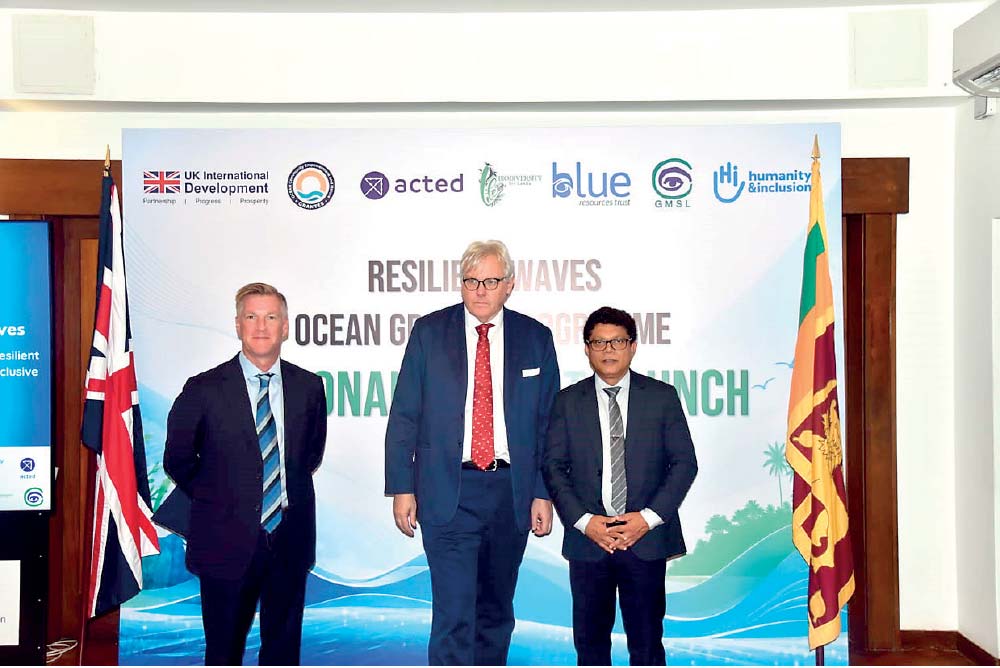
From left: Acted Country Director Ciaran Lavery, British High Commissioner Andrew Patrick and Environment Minister Dr. Dammika Patabendi at the launch
By Charumini de Silva
A new £2.34 million UK-funded initiative, ‘Resilient Waves’, was launched last week aimed at strengthening the climate resilience of Sri Lanka’s coastal fishing communities, while protecting the country’s rich marine biodiversity.
The initiative is funded by the UK Department for Environment, Food and Rural Affairs (DEFRA) through the Ocean Community Empowerment and Nature (OCEAN) grant under the Blue Planet Fund, will be implemented by Acted and other partners till March 2029 in the coastal districts of Batticaloa and Mullaitivu. The stakeholders described the move as a step towards sustainable fisheries, ecosystem restoration, and climate adaptation.
The program seeks to restore critical marine habitats, promote climate-smart fisheries, diversify livelihoods through aquaculture, strengthen fisher governance and increase the participation of women in coastal economies, which can contribute to reducing multidimensional poverty.
Launching the program alongside Environment Minister Dr. Dammika Patabendi, British High Commissioner Andrew Patrick said the initiative builds on the strong environmental partnership between the United Kingdom and Sri Lanka.
Recalling the recent conclusion of the Ocean Country Partnership Program, the High Commissioner said the new initiative reinforces the UK’s long-term commitment to supporting Sri Lanka’s marine conservation efforts.
Describing Sri Lanka as one of the world’s most biodiverse countries, the High Commissioner said many people underestimate the natural wealth the country possesses.
“Sri Lanka is one of the most biodiverse countries in the world. You really are gifted this extraordinary legacy of biodiversity,” he said.
The High Commissioner also stressed that the program has been designed in line with Sri Lanka’s own environmental priorities.
“We are trying to support the lead given by the Government,” the High Commissioner said, thanking the Environment Ministry and its officials for their close collaboration.
Acted Country Director Ciaran Lavery said the award represents another milestone in the organisation’s longstanding partnership with the Environment Ministry, following earlier collaboration on plastics recycling under an EU-funded programme.
He disclosed that the Resilient Waves Program was selected from over 370 applications worldwide, with only four projects ultimately receiving funding. “I think that is really down to the quality of its design, something we can all be very proud of,” Lavery said.
The project is being implemented through a consortium comprising Humanity and Inclusion, Blue Resources Trust Green Movement of Sri Lanka, and Biodiversity Sri Lanka bringing together expertise in biodiversity conservation, habitat restoration, inclusion and community development.
Lavery said implementation has been aligned with Sri Lanka’s Nationally Determined Contributions (NDCs), the National Adaptation Plan, the National Biodiversity Strategic Action Plan and other national environmental priorities.
He also pledged close coordination with Government agencies, academia and other development partners to maximise the programme’s impact.
Providing an overview of the initiative, Acted Programme, Operations and Grants Manager Pindi De Silva said the project responds addresses to three core priorities identified by the UK funding agency; multidimensional poverty, climate change, and responding to exclusion.
He said Batticaloa and Mullaitivu were selected because fishing remains the backbone of local livelihoods, while communities face growing challenges from poverty, degraded coral reefs and mangroves, climate change and declining fish stocks.
Noting that Sri Lanka ranks among the world’s most climate-vulnerable countries, De Silva said the ultimate objective is to help coastal communities build long-term resilience “on their own terms”, while safeguarding the country’s marine ecosystems for future generations.
He also said women engaged in coastal livelihoods continue to face significant barriers to economic participation, making inclusion a central component of the programme.
He said the project will focus on three main pillars. “The first involves restoring degraded coral reefs and mangrove ecosystems through scientific assessments and targeted rehabilitation activities. The second and largest component will promote aquaculture, as an alternative livelihood, reducing dependence on traditional marine fishing. Potential livelihood options include cage culture, sea bass, tilapia and sea cucumber farming, with activities tailored to local conditions following community consultations and collaboration with relevant Government agencies. The third pillar aims to strengthen community participation in coastal governance by enhancing the role of Fisheries Cooperative Societies and newly established aquaculture groups in policy discussions and local decision-making,” he explained.
De Silva said the project will also work closely with the private sector and financial institutions to ensure beneficiaries remain connected to markets and access financing beyond the program’s completion.
“When the project ends, we want these enterprises to continue. The goal is to ensure these community groups are connected to private sector value chains and banking systems so they become sustainable,” he said.




